
Last Updated: October 30, 2026
Quick Summary
Choosing skincare for sensitive skin starts with identifying your personal triggers, such as fragrance, alcohol, and strong acids. Read the full ingredient list, not just the front label, and patch test each new product on your inner forearm and jawline before using it on your whole face.
- Keep a short log of each new product, its start date, and any reaction to spot patterns within about two weeks.
- Check the first five or six ingredients, since ingredients are listed from highest to lowest concentration.
- Patch test on the inner forearm for 5 to 7 days, then the jawline for 3 to 5 more days before full-face use.
- Watch for reactions at minutes, 24 to 72 hours, and up to 5 to 7 days, because some allergic reactions appear late.
- Keep your routine to three or four steps and introduce one new product at a time.
Table of Contents
- What Sensitive Skin Looks Like and How to Spot Your Triggers
- Step 1: Read the Ingredient List Before You Buy
- Ingredients to Avoid for Sensitive Skin
- Best Ingredients for Sensitive Skin and What the Labels Really Mean
- How to Patch Test Skincare Products Step by Step
- Building a Gentle Skincare Routine for Sensitive Skin
- Booking Your First Patch Test and Starting Your Routine
- Frequently Asked Questions
What Sensitive Skin Looks Like and How to Spot Your Triggers
Sensitive skin reacts to things that other skin shrugs off. A new cleanser stings. A moisturizer leaves your cheeks red. Your skin feels tight, itchy, or rough after a routine that used to work fine. Choosing skincare for sensitive skin starts with understanding your own skin, and most people skip that step.
Sensitive skin is a general description, not a medical diagnosis. It means your skin’s barrier reacts more easily to products, weather, or environment. A PubMed Central study on consistent skin care regimens found that gentle, moisturizing products aimed at sensitive skin can help break the dry-skin cycle over time.
Common Signs of Sensitive Skin
Watch for these signs after you apply a product:
- Stinging or burning when you apply it
- Redness that shows up within minutes or hours
- Itching or a tight, dry feeling
- Bumps, flaking, or rough patches
- Flare-ups that come and go with the seasons
If these show up often, your skin likely needs a gentler approach.
Identifying Your Personal Triggers
Triggers differ from person to person. Common ones include fragrance, alcohol, strong acids, hot water, cold wind, and stress. The fastest way to find yours is to keep a short log. Write down each new product, the date you started it, and any reaction. Patterns usually show up within two weeks.
Step 1: Read the Ingredient List Before You Buy
The ingredient list tells you more than the front label. Ingredients are listed from highest concentration to lowest, so check the first five or six. The ingredient list is a useful guide, since many “gentle” marketing claims have no legal definition.
Look for:
- Fragrance or “parfum” near the top
- Essential oils, which can irritate reactive skin
- Denatured alcohol high on the list
- Sulfates in cleansers
Ingredients to Avoid for Sensitive Skin
Reactions are not universal. An ingredient that stings one person may be fine for another, and concentration, formulation, and your own barrier health matter as much as the ingredient name. The useful approach is to know which ingredients are common irritants, why they cause problems, and how to test rather than assume.
Common Irritants and Why They Cause Problems
- Fragrance and essential oils: Fragrance mixes can contain dozens of compounds, and essential oils such as lavender, citrus, and peppermint contain natural fragrance components that can trigger reactions in some people. “Fragrance-free” is a label to check, but see the label caveats below.
- Harsh surfactants (e.g., sodium lauryl sulfate): These strip oils and proteins from the skin barrier. For sensitive skin, gentler surfactants such as cocamidopropyl betaine or glucosides are often better tolerated, though individual tolerance varies.
- Drying alcohols (e.g., denatured alcohol, alcohol denat.): High concentrations can sting and tighten skin. Not all alcohols are drying, fatty alcohols like cetyl and stearyl alcohol are emollients, so read the full list rather than avoiding the word “alcohol.”
- Strong exfoliating acids (e.g., glycolic acid, high-strength salicylic acid): These can inflame reactive skin, especially when used daily or layered with other actives. Lower concentrations and less frequent use may be tolerable for some.
- Physical scrubs with rough particles: Walnut shells, coarse salts, and stiff brushes can create micro-tears. Gentle chemical exfoliation or simply skipping exfoliation is often better for reactive skin.
Ingredients That Are Often Safe, But Not Universally
Some ingredients get unfairly lumped into “avoid” lists. For many sensitive-skin users, these are well tolerated:
- Niacinamide: Often used for calming effects, though some people report stinging at higher concentrations. Start low.
- Hyaluronic acid: A humectant that holds water; reactions are uncommon but possible.
- Ceramides and glycerin: Barrier-supporting and usually gentle.
- Silicones (e.g., dimethicone): Used in many formulations; some people prefer to avoid them.
The goal is not to memorize a banned list. It is to identify your own triggers through patch testing and a product log, then choose formulations that minimize known irritants while keeping the barrier supported.
What Labels Do and Do Not Guarantee
- “Fragrance-free” means no added fragrance, but a product may still contain masking scents or essential oils not labeled as fragrance. Check the full ingredient list.
- “Hypoallergenic” is not a regulated term and guarantees nothing.
- “Dermatologist-tested” means the product was tested on some people, not that it is safe for everyone.
- “Sensitive skin” on a label is marketing, not a standard.
A Practical Rule
Start with the fewest possible actives and add one at a time. If a product stings, stop and note the ingredient list. Over time, your log becomes more useful than any generic avoid list, because it reflects your skin, not someone else’s.
Best Ingredients for Sensitive Skin and What the Labels Really Mean
Look for ingredients that calm and hydrate. Commonly used soothing and barrier-supporting ingredients include:
- Glycerin: A humectant that draws moisture into the skin.
- Ceramides: Lipids that help rebuild the skin barrier.
- Hyaluronic acid: A hydrating ingredient that holds water in the skin.
- Niacinamide: Often used to support a calm, even-looking complexion.
Labels can mislead. “Fragrance-free” means no added fragrance, but the product may still contain masking scents. “Hypoallergenic” is not a regulated term, so it guarantees nothing. Read the ingredient list, not just the claim.
How to Patch Test Skincare Products Step by Step
Patch testing is a useful habit for anyone choosing skincare for sensitive skin. A repeatable protocol gives you interpretable results instead of guesswork. The goal is to catch reactions before a product touches your whole face and to learn what different reactions mean.
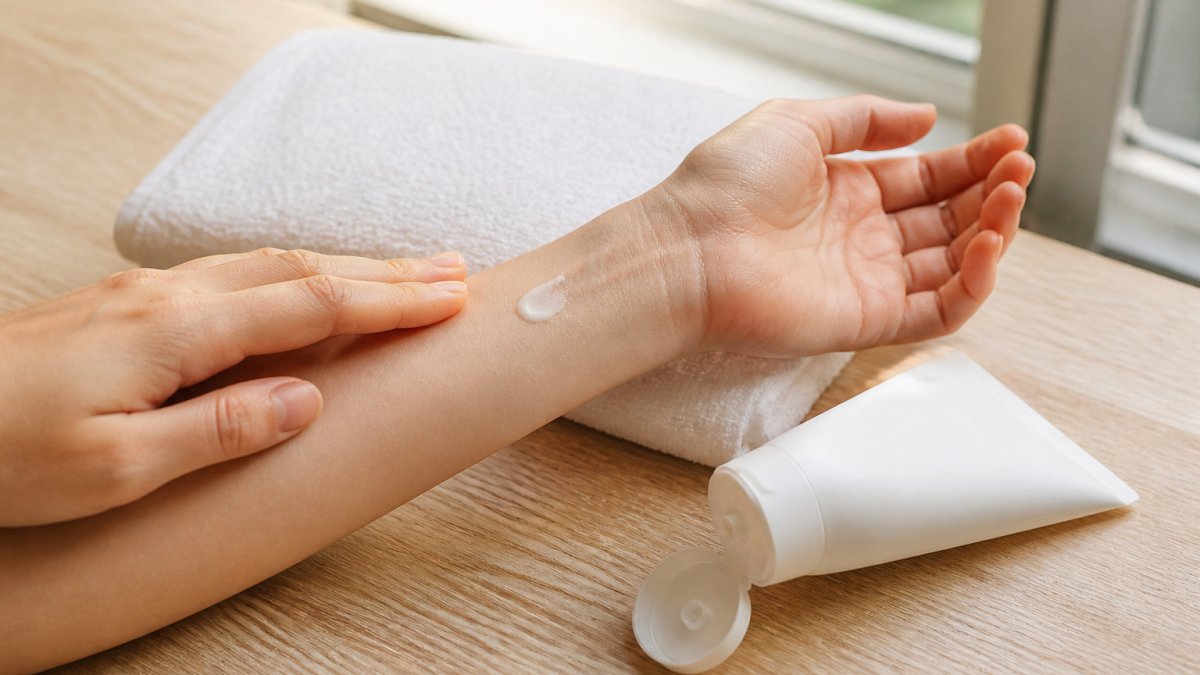
Where to Test
Use two sites in sequence:
- Inner forearm, convenient and low-stakes for a first pass. Apply a coin-sized amount to a 2-3 cm area.
- Jawline or behind the ear, closer to facial skin thickness and oiliness, so it is a better second check before full-face use.
Avoid testing on broken skin, active breakouts, or areas you have recently exfoliated, since those will react to almost anything.
How Long to Wait
A common pattern used in patch testing:
- Immediate reaction (minutes to 2 hours): stinging, burning, or rapid redness. This is usually irritation or intolerance, not allergy. Wash it off with lukewarm water and do not retest that product.
- Delayed reaction (24-72 hours): redness, itching, bumps, or flaking. This can be irritation or a mild allergic response. Stop the product and note the timing.
- Late reaction (up to 5-7 days): some allergic reactions, especially to fragrance or preservatives, appear days after first contact. This is why a single 24-hour test is not enough.
A practical schedule: apply once daily for 5-7 days on the forearm. If calm, repeat on the jawline for another 3-5 days. Only then move to full-face use.
What Reactions Mean
| Reaction | Likely meaning | What to do |
|---|---|---|
| Stinging or burning within minutes | Irritation or barrier disruption | Wash off; avoid the product; check for acids, alcohol, or fragrance |
| Redness and itching at 24-72 hours | Irritant or early allergic response | Stop; note the ingredient list; consider a second test after skin settles |
| Bumps, swelling, or spreading rash | Possible allergy | Stop all new products; see a dermatologist if it persists or worsens |
| No reaction after 7 days | Likely tolerable for now | Introduce gradually; keep monitoring for 2-3 weeks |
Patch testing reduces risk but does not eliminate it. If you have a history of eczema, rosacea, or known allergies, test one product at a time and keep a written log of dates and reactions.
Common Patch-Testing Mistakes
- Testing several new products at once, which makes it impossible to identify the culprit.
- Testing only for 24 hours and assuming a product is safe.
- Applying to the face first because “it’s just a little.”
- Ignoring a mild sting because it fades, repeated low-grade irritation can weaken the barrier over time.
A patch test is not a guarantee, but a consistent protocol turns vague reactions into useful information you can act on.
Building a Gentle Skincare Routine for Sensitive Skin
A simple routine works best. Keep it to three or four steps:
- Cleanse: Use a creamy or milky cleanser, and avoid rubbing hard.
- Treat (optional): Add one active only if your skin tolerates it.
- Moisturize: A barrier-supporting cream locks in hydration.
- Protect: Daily sunscreen prevents irritation from UV exposure.
Pat your skin dry instead of rubbing it. If you want a complete set of options, our dermatology guidance on gentle daily skincare outlines sensible basics. For the full layering order, How to Build a Simple Skincare Routine: Step-by-Step walks through each step.
Booking Your First Patch Test and Starting Your Routine
Start small and stay patient. Introduce one new product at a time, patch test it first, and give your skin two to three weeks before judging it. Keep your trigger log going so you can spot problems early.
If irritation persists for more than a couple of weeks, or if you notice swelling, blistering, or spreading redness, stop the products and see a dermatologist. Skin that reacts repeatedly can signal a condition that needs professional care.
Once you have a short list of products that pass the patch test, you are ready to build your routine. Browse Beauty Fresh Essentials to find skincare options that suit your routine.
Frequently Asked Questions
How can I know if my face skin is sensitive?
Sensitive skin usually reacts quickly to products or conditions, showing stinging, burning, itching, tightness, or redness that appears within minutes or hours of use. Track when these reactions happen and which products or situations preceded them. If your skin reacts to several common products, or irritation lasts beyond a few days after you stop using something, your skin is likely sensitive. A dermatologist can help confirm whether the cause is sensitivity, an allergy, or a skin condition such as rosacea or eczema.
Which ingredients should people with sensitive skin avoid?
Common irritants include added fragrance and essential oils, high concentrations of alcohol (listed as denatured alcohol or alcohol denat), harsh sulfate cleansers such as sodium lauryl sulfate, and strong exfoliating acids used at high strength. Products labeled fragrance-free or alcohol-free reduce the chance of an unexpected reaction. Introduce any new active ingredient slowly, because even gentle formulas can irritate skin that is already reactive.
How should I patch test a new skincare product?
Apply a small amount of the product to a discreet area such as the inner forearm or behind the ear once a day for three to five days. Leave it on and watch for redness, itching, bumps, or stinging. If nothing happens, try it on a small area of the face, such as along the jawline, for several more days before using it everywhere. Stop immediately if a reaction develops and wash the area with plain water.
What is a basic skincare routine for sensitive skin?
A simple routine includes a gentle, fragrance-free cleanser used morning and evening, a moisturizer that supports the skin barrier, and a broad-spectrum sunscreen during the day. Pat skin dry rather than rubbing it. Add one new product at a time and wait at least one to two weeks before introducing another, so you can identify what, if anything, causes a reaction.







0 Comments